Patented mechanical bonding· Granted CA · US & PCT pending

Combine. Compound. Without compromise.

A patented mechanical method that joins sheet metals — any metals, any thickness, perforated or solid — using engineered Nexus points. No welds. No adhesives. No heat. Just geometry, doing the work of every joining process you currently rely on.

686NPeak peel force
tested independently
×1.47Stronger than
double spot weld
0kJHeat input
cold-formed
3FILINGSCA granted
US, PCT pending
Scroll
Any metals Any thickness Perforated or solid Programmable mechanics Cold-formed structural bond Fully recyclable Any metals Any thickness Perforated or solid Programmable mechanics Cold-formed structural bond Fully recyclable
section01 · the problem

A century of joining methods.
Each with a hidden cost.

01 · welding

Heat-affected zones distort thin sheets, reduce fatigue life, and disqualify many dissimilar-metal pairs entirely. Aluminium-to-steel? Not really.

Heat damages
the parent metal.

02 · adhesives

Epoxy and polyurethane adhesives degrade with UV, temperature, and time. Solvents and resins are environmentally costly and add line cost.

Chemistry fails.
Slowly.

03 · riveting

Mechanical fasteners punch holes that concentrate stress, invite corrosion, and add weight and part count to every assembly.

Holes weaken
the surface.

04 · everything

Welds, glues, rivets — none come apart for repair or recycling. End-of-life means shredding, contamination, and downcycled scrap.

Nothing comes apart cleanly.

section02 · the proof

A bond that outperforms
spot welding and epoxy.

0N
Nexus joint, peel test peak force · verified at Mohawk College IDEAWORKS
Joining methodConfigurationAvg. force (N)Peak (N)Strength
Nexus jointPerpendicular to peel686.2 ± 48822
Double spot weldTwo welds, ¼″ each467.2 ± 154599
Nexus jointParallel to peel413.9 ± 22470
S-10114 horizontalSanded + crimped243.0 ± 64311
S-10114 horizontalJust tape210.2 ± 35249
Metal bond epoxySanded substrate117.5 ± 22136
Source · Mohawk College IDEAWORKS · comprehensive bond evaluationMethod · ASTM-equivalent peel · n ≥ 5 specimens per configuration

0Peak Peel Force, Tested
0Stronger Than Spot Welds
0Heat Input · Cold-Formed
0Metal Pairings Supported
0Recyclable · Separable
section03 · the technology

Geometry, not chemistry.

formationNEXUS POINT BONDING
01

Variability of thickness & size.

Two sheets of any compatible thickness can be combined — from foil-thin claddings to structural plate. The forming geometry adapts to the stack.

02

Flexibility of shape & form.

Every parameter of the Nexus point — size, pitch, orientation, density — is a knob. Pattern arrangements vary across a single sheet to suit the load case.

03

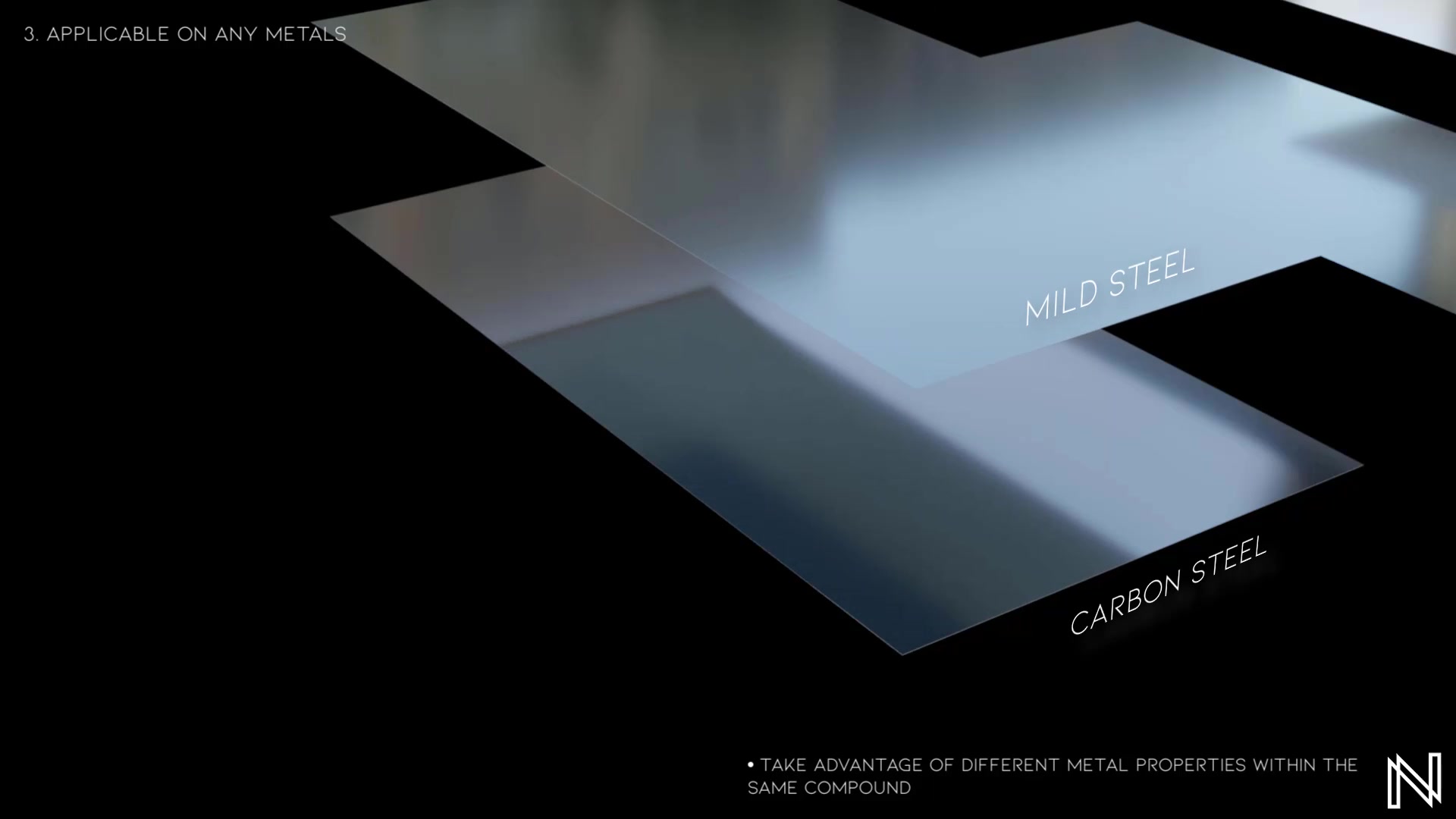
Applicable to any metals.

Aluminium to steel. Steel to copper. Foil to plate. The bond is mechanical — chemistry isn't a constraint, so dissimilar metal pairs aren't either.

04

Works on perforated sheet.

Mesh, expanded metal, perforated plate — all join cleanly. Voids in the surface become opportunities to layer in damping, insulation, polymer.

section04 · the unlock

Tune the joint.
Tune the material.

Because the bond is geometric, the same material exhibits different mechanical behaviours simply by changing how the Nexus points are arranged. One sheet. Many properties.

01 · density

Localised
stiffness.

Dense Nexus point arrays where the structure must hold. Sparse where it must yield. Single sheet, multiple flexure moduli — engineered by pattern alone.

02 · orientation

Predictable
deformation.

Orient Nexus points to dictate fold direction under load. Engineer crumple zones into chassis, hulls, and panels — controlled energy transfer, by design.

DAMPING / INSULATION
03 · layering

Function in
the void.

Perforated sheets bond cleanly with Nexus points — and the cavity between can carry plastic, polymer, fibreglass, polystyrene. Multi-functional in one bond.

section05 · industries

Where the joint matters.

Nexus points appear inside a body-in-white, a fuselage skin, the underside of a hull. Wherever sheet metal is joined, the technology fits — invisibly when desired, programmatically when designed. Six industries. Six unlocks.

01 · Automotive/Body-in-white · EV battery · Chassis

A body designed
to crumple correctly.

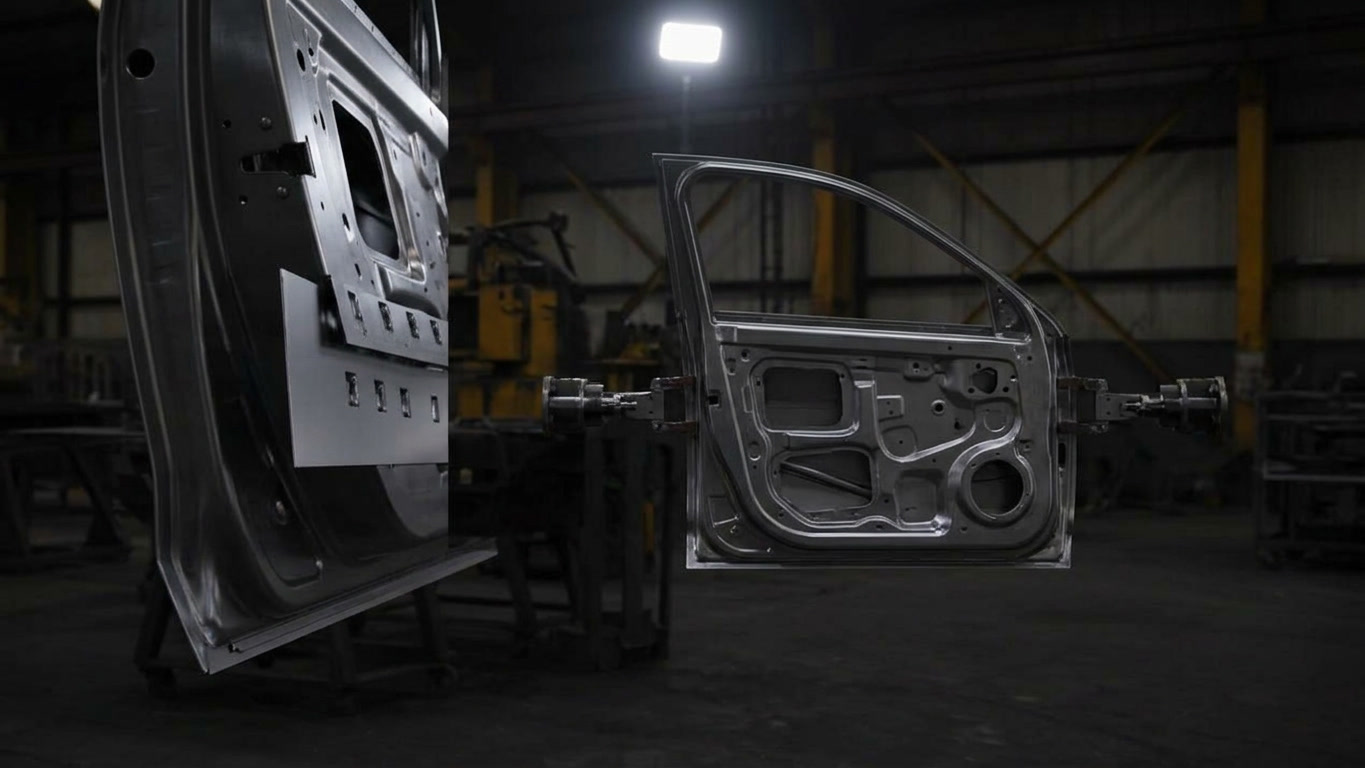
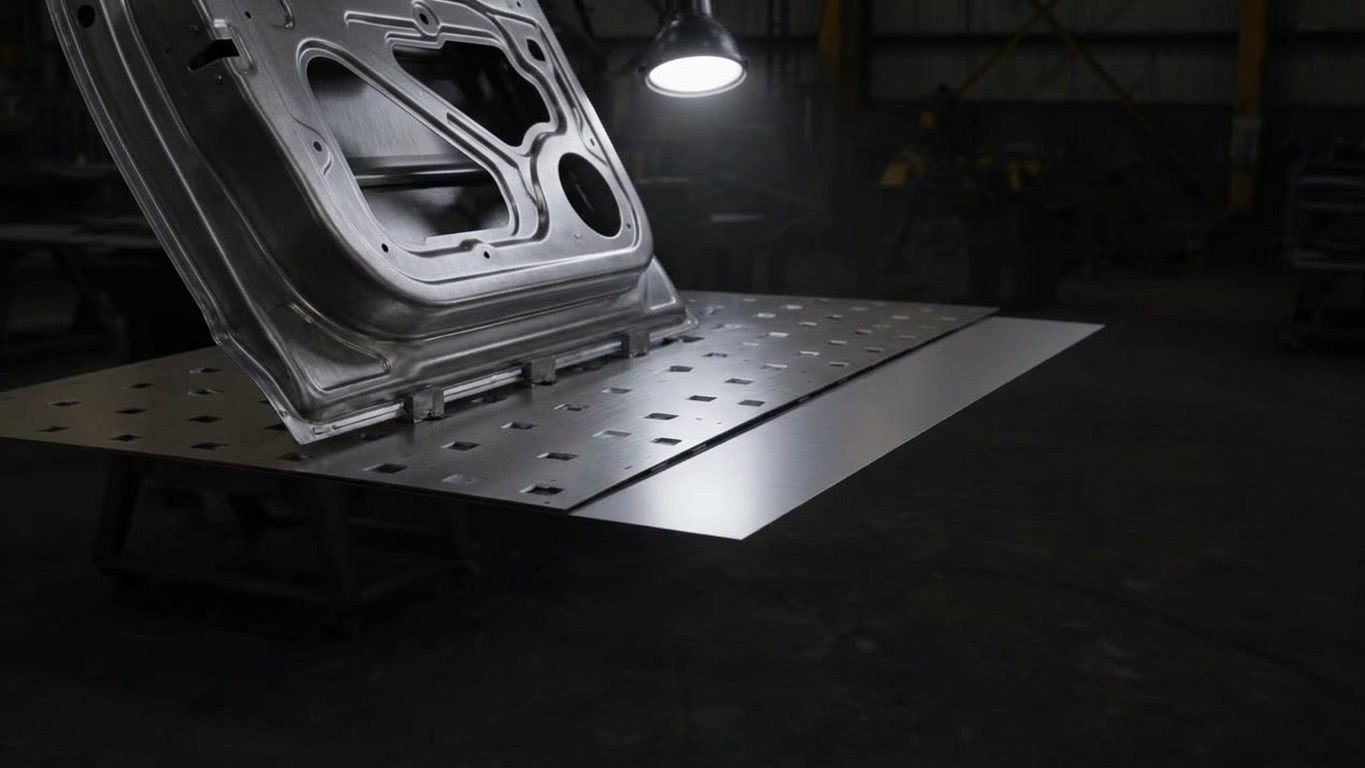
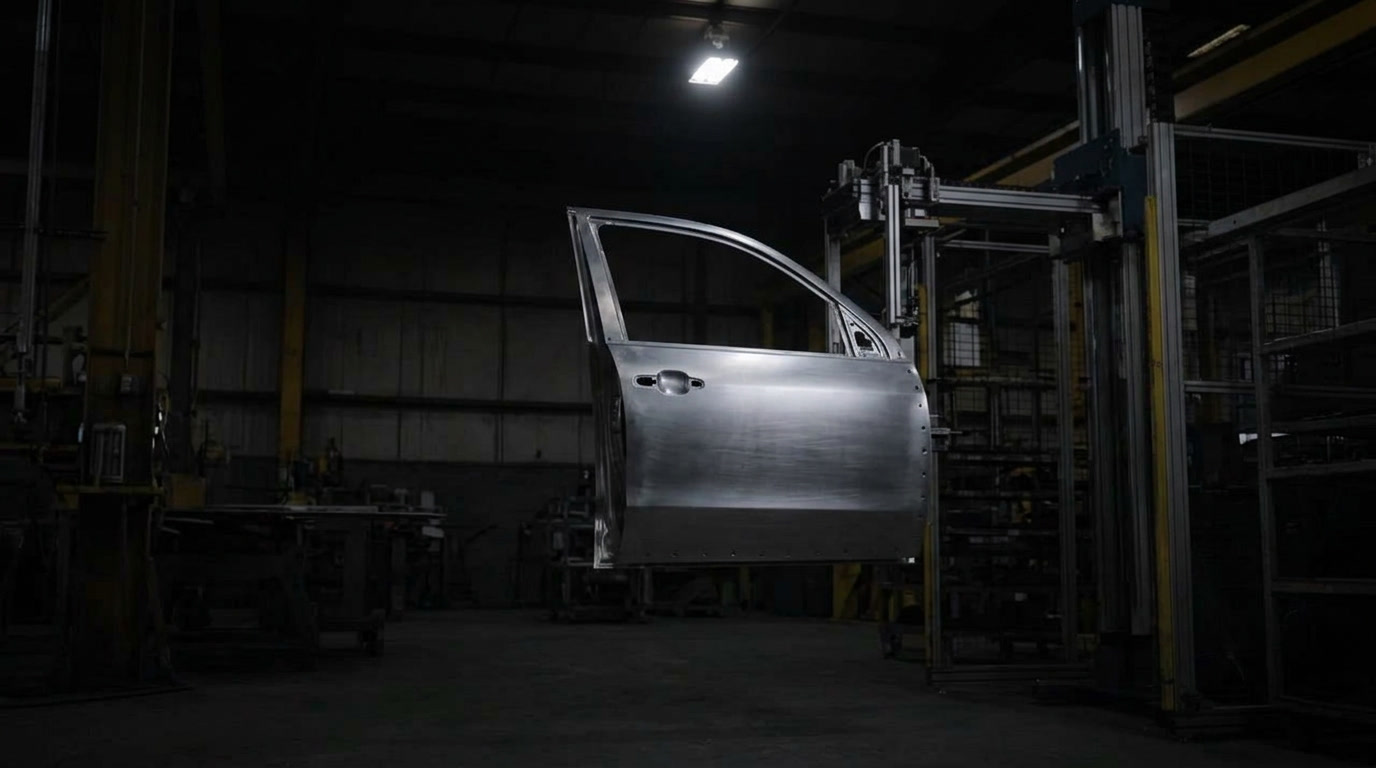
Replace welded body-in-white assemblies with mechanically bonded sheet. Reduce mass without losing crash performance — or use Nexus points to engineer crumple behaviour directly into the geometry of the joint. Predictable energy transfer, designed in, not bolted on.

×1.47Stronger than spot welds in peel
0kJHeat input — cold-formed joint
Al + FeDissimilar metals joined directly
Body-in-whiteEV battery enclosuresCrumple zonesAcoustic floor panelsDoor inner panelsWheel arches
specimenNX-AUTO-04 · DOOR INNER PANEL
02 · Aerospace/Fuselage · Wing skin · Floor beams

Skin without
rivets.

Replace fastener fields in stressed-skin panels with continuous mechanical joints. Every removed rivet is a stress concentrator eliminated and an inspection point gone. Cleaner aerodynamics. Longer fatigue life. Lower mass per square metre of skin.

−18%Skin assembly mass vs riveted baseline
0Fastener holes per bonded seam
Al + TiBonded directly without isolation
Fuselage panelsWing skinFloor beamsCargo baysHoneycomb skinsNacelles
specimenNX-AERO-02 · WING SKIN
03 · Marine/Hulls · Decks · Bulkheads

Lighter hulls.
Lower drag.

A bonded hull is a lighter hull — and Nexus points create a second-order advantage: microscopic air pockets trapped on the underside reduce fluid contact with the metal. Less drag. Better fuel economy. Fewer emissions per nautical mile.

−15%Hull plating mass vs welded baseline
~6%Drag reduction from surface geometry
0kJHeat input — no warping
HullsDecksBulkheadsDrag-reducing surfacesSuperstructureOffshore platforms
specimenNX-MAR-12 · HULL SECTION
section05B · also deployed in

Three more industries.

in contextconstruction
04 · construction

Light steel.
Heavy facade.

Bond a structural steel core with alternative cladding — granite, precast, brick — at a fraction of the support steel weight. Separable at end of life.

Pre-engineered buildingsCladdingAcoustic wallsInsulated panels
in contextrenewable energy
05 · renewable energy

Lighter blades.
Stronger towers.

Fits wind nacelles, solar mounts, and grid-scale balance-of-plant. Reduce structural mass without trading off load capacity.

Wind nacellesSolar mountsBattery housingsTransmission
animationnexus container build
06 · logistics

59% less
deformation.

Under identical 1MP vertical load, a Nexus container deforms 0.044mm vs 0.108mm standard. Factor of safety 1.83 vs 1.22. Separable at end of life.

Shipping containersCold-chainSpecialty enclosuresModular panels
section06 · ip & validation

Granted, pending, proven.

granted

Producing Single Sheet Metal From Two Separate Sheets

Inventor · A. Torabi · CA 2,757,375
21 Mar 2016
pending

Combined Sheets and Method & System for Producing Same

A. Torabi, F. Torabi · 10856479 Canada Inc · US 17/045,525
06 Oct 2020
pending

International filing — PCT /CA2019/050994

Covers product, method, and system · roll-forming + punch-press apparatus
PCT
Independent validation

Tested at Mohawk College IDEAWORKS.

Nexus partnered with the Mohawk IDEAWORKS centre to run a comprehensive bond-strength evaluation comparing the patented joint against welding, adhesives, and combined methods. Peel and three-point bend tests were conducted on multiple specimen configurations.

The result: Nexus joints outperformed double spot welds by approximately 47% in peel force, and exceeded epoxy bonds by nearly 6×. Bend test data confirmed tunable stiffness across alternating-indent configurations.

M
Mohawk IDEAWORKSapplied research partner
Partnership· open for engagement

Build with us.
Or build around us.

We license the Nexus method to manufacturers, integrators, and OEMs ready to leave welds and adhesives behind. Joint development. Technology transfer. Strategic equity. Each path is on the table — pick the one that fits your roadmap.

i

Manufacturers & integrators

License the method. Integrate the apparatus into your line.

ii

OEMs & product teams

Joint development on a specific application — chassis, hull, panel.

iii

Strategic & equity partners

Long-horizon partnerships. Capital, supply chain, market access.

iv

Materials suppliers

If you sell sheet, we want to talk about volume.

F. Torabi · Toronto
Founder & Chief Executive Officer

Faraz Torabi.

Every method we use today to join metal carries a hidden cost — heat, weight, contamination, or end-of-life waste. Nexus is the answer we've been engineering for a decade. If joints matter to your product, I'd like to hear from you.